

When preparation meets opportunity
 Advocacy & Funding
By Tabitha Whissemore
April 22, 2026
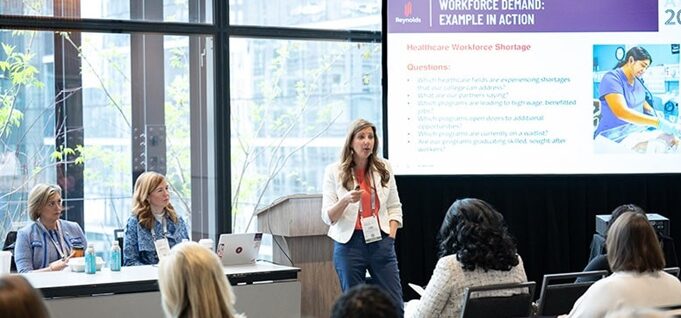
Like most community colleges, J. Sargeant Reynolds Community College has had to look beyond state funding to serve the region and scale programs. Closing funding gaps requires innovation and intentionality, Paula Pando, president of the Virginia college, said during a session this week at the American Association of Community Colleges annual convention.
Reynolds is the third-largest community college in the state, serving about 15,000 students annually, with enrollment growing. In the region, there’s an expanding demand for talent in healthcare and technology, and employers are looking to Reynolds to help meet that demand.
A focused approach
Reynolds takes a “focused approach” when deciding what programs to develop or scale – and how to fund those programs, according to Lori Dwyer, vice president of academic affairs. That approach starts with listening.
“We spend a lot of time listening in our community about where the need is,” Dwyer said.
The college listens to employers and other stakeholders to identify where the workforce demand is – but also to determine what programs and partnerships align with the college’s mission. Specifically, it wants to know how much program graduates can earn. That helps determine where Reynolds will invest time and money.
“We’re not taking a guess,” Pando said.
Institutional research staff at the college also examine local and state economic development data to gauge job openings, wages and more. For example, there’s a need for phlebotomists in the region, but that job often doesn’t pay a family-sustaining wage. So, while Reynolds does train phlebotomists, the college isn’t making a push for funding to scale up the program.
“We do not chase the funding – we chase the economic mobility and create to strategies to drive the funding,” Dwyer said.
Lindsay Lane Robinson, vice president of institutional advancement, echoed that sentiment: “The mission should be driving everything, not the dollars.”
Launching the right campaign
Unlike phlebotomy, nursing does pay a higher wage and includes benefits. And there’s a growing demand for more skilled nurses in the region. Reynolds currently serves about 200 nursing students, and its program has a good reputation. But the region needs about 800 new nurses yearly. So, it was the right time to seek investment.
Before jumping into a fundraising campaign to expand its healthcare program, Reynolds conducted a feasibility study to ensure the community would support the campaign.
“The worst thing would be to launch a campaign and realize no one cares,” Robinson said.
The community – including the leading healthcare employers – did, in fact, care. Reynolds launched a $20 million fundraising campaign for healthcare programs.
The college created a funding narrative to ensure people would feel good about investing in the college and know that Reynolds would deliver on its promise. A funding narrative lets potential donors know about the college’s reputation and the impact their investment would make – not just to students, but to the whole community.
“It’s our reputation that allows employers and other entities to feel confident,” Pando said.
An early investment of $5 million helped to build momentum for the campaign.
“When investment comes in, more people want to invest,” Robinson said.
And the campaign doesn’t just rely on funding from private funders or foundations, but also local and federal funding, as well as employers. Reynolds received a $2.3 million federal Fund for the Improvement of Postsecondary Education (FIPSE) grant in February.
The college has raised about half the funding in six months, and has a plan to raise the rest. Robinson predicts the $20 million campaign will likely raise about $30 million.
Be prepared
Fundraising isn’t about luck – it’s about preparation, Pando said. Having the data ready, having programs ready for investment and having a reputation for excellence means being able to respond quickly to funders when they’re ready to invest.
“Our opportunities are maximized because we’re prepared,” she said.
Because of Reynolds’ preparation, the healthcare campaign will bring major wins to the Richmond community.
“It’s a win for students that have access to a program that leads to family-sustaining wages. It’s a win for the employer, and it’s a win for the community,” Pando said.
This article was originally published in CC Daily.