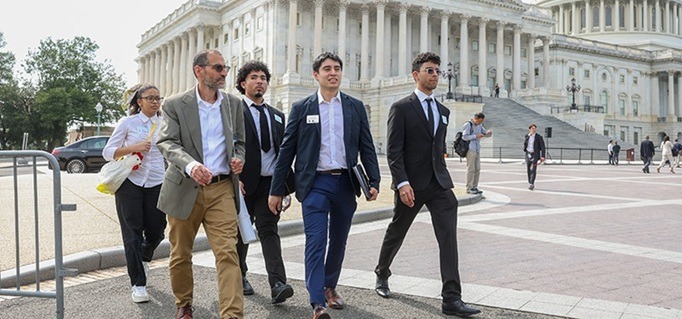
Lessons from last year’s CCIC-winning team
 Mission & Values
By Ed Finkel
March 18, 2026
The Community College Innovation Challenge, co-sponsored by the American Association of Community Colleges and the National Science Foundation, challenges students to pitch a STEM-based innovation to address a real-world problem, with guidance from a faculty mentor.
Members of last year’s winning team from Bergen Community College (New Jersey), who undertook a project called “Pop-Up Hydroponic Farms Made From Recycled Materials,” say it was a growthful experience that has had ongoing ripple effects on both their career outlook and self-confidence.
The 2026 competition will culminate in the annual Innovation Boot Camp, scheduled for June 8-11 in Washington, D.C., where finalists will pitch to a panel of judges in the “Shark Tank”-like presentation for cash awards. They also participate in a poster session on Capitol Hill attended by leaders in the STEM field and congressional stakeholders, while receiving professional development, mentoring and coaching to advance their entrepreneurial and strategic communications skills.
Apply for the 2026 Community College Innovation Challenge by April 3.
Last year’s weeklong trip to the nation’s capital included educational sessions on building business and entrepreneurial skills, hands-on workshops on communication and pitching ideas, the poster presentation and rehearsing their talk, and then doing the five-minute presentation to a panel of judges, recalls Bergen team member Estrella Luna.
Besides the pitch presentation — and the team’s victory — Luna enjoyed meeting other students, who were in a similar place in life despite a range of ages and individual experiences.
“Even though we were all quote-unquote ‘competing’ with each other, we would all hang out after our presentation,” she says. “I thought that was super cool, to be in a room with like-minded people, beyond making connections on LinkedIn.”
The CCIC competition opened Bergen team member Derek Gonzalez’s eyes to a world he hadn’t known before. In the past, he had made presentations mostly in technical contexts at Bergen or the New Jersey Institute of Technology.
“What I learned from CCIC was knowing your audience,” he says. “Presentations that you do in that [technical] context are extremely different from what CCIC was asking for, but what CCIC was asking for is equally important. It’s one thing to get a lab pilot running; it’s another to get investors interested.”
Growth of the growing system
Finalist teams from 12 community colleges around the U.S. attended last year’s competition.
The Bergen team — which created pop-up hydroponic farms from a stack of recycled shipping pallets with LED lighting placed in vacant commercial spaces — included Gonzalez, Luna and fellow students Lisandro Martinez and Alejandro Olarte, with mentorship from chemistry professor PJ Ricatto.
Students drew inspiration from a 2023 study in the Journal of Obesity, which revealed that among adults in New Jersey, only 26% eat the recommended five servings of fruits and vegetables per day. The team’s innovation of constructing three-tiered towers would temporarily transform vacant spaces into community centers for food production, providing area residents with fresh produce. In areas with food deserts and retail vacancies, “You’re killing two birds with one stone,” Luna says.
The big-box store locations enabled these operations to be year-round. The team approached landlords to say, “While you’re waiting for the next tenant to come, why not use this? Once you get your next tenant, we just pull them right out,” Ricatto recalls.
“We thought we could repurpose those spaces as urban community spaces where community members could participate in food production and learn about the process,” Gonzalez adds. For example, “There’s a huge Sears building in Hackensack that’s still being maintained, the owner is pouring money into it and essentially all this energy is going nowhere.”
Developed over a year
Both Luna and Gonzalez initially became involved through the STEM Student Scholars Program at Bergen, a paid summer position that pairs them with a faculty member on a project. It’s how they both connected with Ricatto.
Three of the four students on the team had taken one of his chemistry classes, but that’s not always how it’s worked in the past, says Ricatto, adding that the college has made the CCIC finals competition three times and won twice.
The team spent the summer of 2024 testing different systems, including soil-based growing, undertaking a literature review focused on food insecurity both generally and in New Jersey, and exploring vacancies in the local commercial real estate market, says Luna, who received her associate degree in biology last year and now attends Rutgers University.
Gonzalez, a chemistry major at Bergen now studying chemical engineering at Rutgers, says their efforts progressed in linear fashion after that summer. Gonzales continued working with Ricatto throughout the 2024-25 school year; that’s when PJ brought up the CCIC opportunity.
The CCIC experience
Ricatto says he’s never seen a more organized venue for students or a place where students are more engaged than during CCIC.
“They treat students like professionals the whole time,” he says. “They really get to know all of the students. It’s really about the experience — the winning is just the icing on the cake.”
The camaraderie that students build with one another has been another highlight for Ricatto each time he’s attended.
“Hopefully, they don’t look at the other teams as competition,” he says. They’re trying to help each other. They learn about entrepreneurship and bringing a product to market. They’re not just science students; there’s business students, also.”
But winning the competition was certainly sweet, Ricatto says.
“The other projects were so good, the ideas were so life-changing, I was like, ‘How did these people come up with this? The quality of the presentation were [what you would expect from] graduate students,” he says.
There’s more to the story! Read the full article in CC Daily.