Creating a pipeline for CNC careers
 Skills Gap
By Eric Devlin
February 11, 2026
As production manager at Branch Medical Group, a medical equipment manufacturer based in Royersford, Pennsylvania, Brad Bouchard knows firsthand the demand for machinist computer numerically controlled (CNC) operators. His plant can’t hire them fast enough.
“It’s very hard to find people to do that,” he said. “And in all honesty, really good operators right now, if they’re at a company, they’re holding on to them for dear life.”
Branch Medical Group is a subsidiary of Globus Medical, a global musculoskeletal technology company, and manufactures implants for spinal and orthopedic applications.
To address this talent shortage, Bouchard has been working with the workforce development team at Montgomery County Community College (MCCC) to train the next generation of operators.
A CNC operator is responsible for the hands-on operation of computerized machinery within a manufacturing environment. Their core duties include loading pre-written programs, setting up standard tooling and fixtures, and performing routine quality inspections to ensure parts meet specifications. Additionally, operators maintain safety procedures, manage materials and perform basic machine maintenance and troubleshooting throughout the production run. Meanwhile, a machinist is trained to manually create CNC programs and refine the operating sequence to meet high-precision industry standards.
MCCC’s Machinist-CNC Operator program offers a certificate of completion, teaching essential skills like blueprint reading, tool identification and CNC mill operations. Graduates are prepared for entry-level positions in manufacturing and precision-machining industries.
“It’s a program that resonates with the industry,” said Bernadette Debias, MCCC’s director of workforce development. “By aligning training with employer and industry needs, it is improving job placement outcomes for students and elevating workforce development. Our industry partnership with Branch Medical has been outstanding.”
Thomas Ross III, who directs the workforce development industrial and IT program, noted the program moves people into careers quickly.
“You can start a career making a livable wage in only eight or nine months,” he said.
Working hand-in-hand
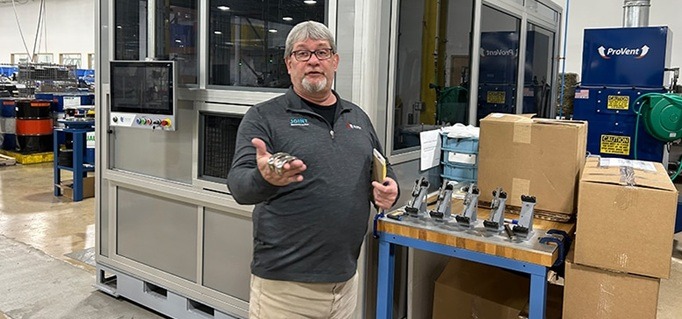
Bouchard has established a strong collaboration with MCCC. In addition to speaking to classes and giving student tours of Branch’s facility, he discusses the curriculum and knows that students are leaving the program with foundational skills, ready to work.
“Students will leave the program with the skills and training needed to begin work at Branch,” he said. “They will build on those skills as they continue into their careers.”
John Mest, part-time industrial trainer at MCCC, said the demand for operators is high.
“Our goal is to have them ready to use tools, operate equipment, measure the parts they’re making, read blueprints and understand what they’re seeing to produce good parts — and get a good job,” Mest said.
Providing a livable wage
Nationwide, machinist CNC operators earn a livable wage. According to a 2023 U.S. Bureau of Labor Statistics survey, 90% of CNC operators earn an average salary of $66,970. Pennsylvania, meanwhile, ranked fifth in states with the highest employment level in CNC operators with 11,910 and an annual mean wage of $53,920.
Bouchard said salaries at Branch continue to progress as employees advance through the company.
Brookings Institute named materials machining/fabrication as one of three key industry clusters in southeastern Pennsylvania that can help the region become economically prosperous and compete in the global economy. Montgomery County is a regional hub for manufacturing. According to the state’s Montgomery County Workforce Development Area profile, manufacturing provides more than 44,000 jobs.
“Montgomery County has the highest concentration of manufacturers in Pennsylvania, and they are offering family-sustaining jobs,” said Ross. “Working with industry partners, like Branch Medical Group, this certificate program is designed to prepare students to hit the ground running.”
This article was originally published in CC Daily.