CCIC opens doors for students
 Mission & Values
By Matthew Dembicki
February 25, 2026
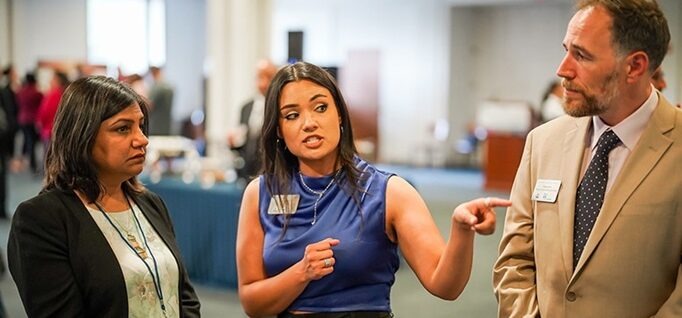
Briana Wood is used to getting invitations to speak at local and national events. Just last week, the Virginia Western Community College graduate came to Washington, D.C., to participate in a panel discussion at a workforce development meeting held by the American Association of Community Colleges (AACC).
Wood, who is now pursuing a bachelor’s degree in mechanical engineering technology, credits the Community College Innovation Challenge (CCIC) for giving her the confidence to speak at these events. CCIC is an annual national competition comprising student teams who pitch STEM-focused projects for cash prizes. It also includes a boot camp that provides student teams with professional development, mentoring and coaching to build their communication and entrepreneurial skills to help promote their innovations.
Wood was a participant in the 2023 CCIC, where her team — the college’s Appalachia Engineers Club — was among the 12 college squads selected for the final stage of the competition, which included a poster session on Capitol Hill before congressional representatives, staffers and other government officials. Those focused elevator pitches she learned during the boot camp came in handy during the presentations, and they’ve stayed with her over the years as she has applied for internships and other endeavors. She said CCIC had taught her how to market herself better.
“It was an amazing experience, one that I would highly recommend,” said Wood, 29, who aspires to become a trackside engineer for an International Motor Sports Association Grand Touring race teams.
Supporting mentors
Community college staff members as well as faculty in all disciplines and administrators are eligible to mentor student teams for CCIC, which AACC offers in partnership with the National Science Foundation (NSF).
Wood credits her biology professor for pushing the engineering club to join the competition. She said the group already had a bond because they would work together on projects outside the classroom. Getting selected to participate in CCIC was a high point for the group, which developed as its CCIC project an automated sorting mechanism to assist the Ronald McDonald House Charities of Roanoke, Virginia, in their recycling efforts of donated pull tabs and bottle caps.
“It was like a pat on the back for us,” Wood said.
This article was originally published in CC Daily.